In international practice, there is a concept called the Challenge Grant.
A fund says: "We will give you $1 million, but only if you secure another $1 million yourself—from businesses, private donors, or local budgets."
It's a simple, honest mechanism. It discourages dependency and filters out those who just "want money." Instead, it rewards those who can negotiate, calculate ROI, and build coalitions.
I work within this exact logic—even though in Russia, the formal name is the "All-Russian Competition for Best Projects in Creating a Comfortable Urban Environment."
My role is to help city administrations assemble and launch a project that meets strict federal requirements, attracts co-financing, and wins the grant. This isn't charity. It is an investment leverage tool.
My Role: Producer of the City Bid
I am often asked: "Ksenia, are you an architect or a manager?" In practice, that's a false choice.
In any major public project, there is a conflict of interests:
- The Architect wants it to be beautiful (and often expensive).
- The Manager wants it on time and on budget.
- The City Administration wants to pass all bureaucratic checks.
- The Residents want a space that serves their specific needs.
- The Business wants economic traffic.
Bids fail because these logics don't align. My role is to be the convergence point. I work as a contractor for city administrations, acting as the project producer: I assemble the team, synchronize architects, sociologists, economists, and business partners, and take responsibility for the integrity of the final result.
I don't draw with a pencil. I connect meanings, regulations, money, and people into one working product.
Why Is the Small Towns Competition a Challenge Grant?
Here is the deal structure:
- The Federal Government provides the core funding for hard infrastructure: utilities, paving, lighting, and landscaping.
- The City/Region provides matching funds.
- Local Business creates the "life" on top of that infrastructure.
The government essentially tells cities: "We are ready to invest in you—but only if your research proves that local business and residents actually need this."
Over the last few years, my team has submitted 11 bids. 10 of them won, attracting a total of approximately $13 million—including federal funds and co-financing.
How It Works in Practice
Step 1. Translation from "Architectural" to "Bureaucratic"
Architects often design an ideal picture. My task is to reality-check it against rigid regulations.
- Will this pass the State Expertise review?
- Does it comply with the updated Ministry construction codes?
- Are we encroaching on land we don't own?
Recently, I halted a project where the client wanted to include a piece of railway land. Formally, it looked fine. Factually, it carried a risk of criminal liability for misuse of funds. I cut those risks immediately.
Step 2. Decoding the Territory
We don't design in a vacuum. Even if it's a remote region in the Far East, we send expedition teams to find the territory's Unique Value Proposition.
We ask the residents directly. One neighborhood says: "We need quiet and safety." The neighboring one says: "We need a playground and events." My job is to synthesize these contradictions into a unified Technical Assignment that doesn't destroy the community fabric but knits it together.
Step 3. The Business Component: Not "Sponsorship," but "Economics"
The Federal Grant builds the stage; business provides the actors.
I don't ask businesses for charity. Through our economic research, we identify what the local market needs.
- The Deal: The government builds the promenade (CAPEX).
- The Business: Commits to opening a cafe, a rental service, or a shop (OPEX) because the new infrastructure guarantees foot traffic.
Our application proves to the commission that the money won't be buried in concrete, but will spark local economic activity.
Case Studies
The Far East: Agro-holdings and the War for Talent
Small settlements (6k–10k people), with the agricultural sector as the main employer. If there is nowhere to go in the evening, young specialists leave the village. The quality of the urban environment directly affects staff retention. Agro-companies supported the project as an investment in their own HR brand, committing to maintain the spaces and fund events.
Vetluga: Revitalizing a Historic Center
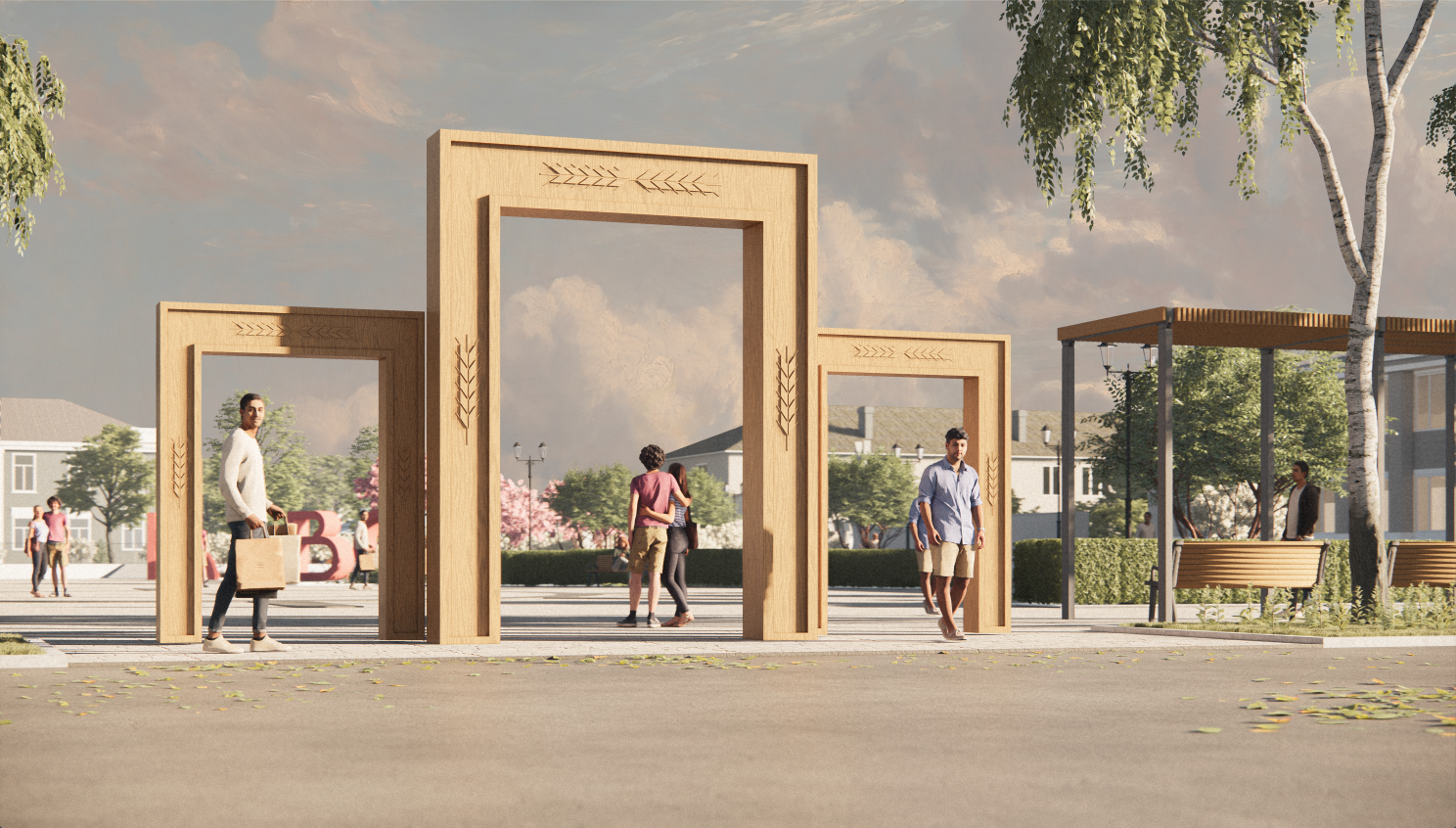
A historic town needing an economic impulse. We developed full design and estimate documentation for the center's reconstruction. Even before construction ended, owners of historic buildings nearby started renovating their facades at their own expense. The grant signaled that the location's value was about to rise, triggering private gentrification.
Why This Matters
Modern Urban Strategy isn't just about benches and paving stones. It is the skill of assembling a working model out of the disjointed interests of residents, the state, and private capital.
It's about resourcefulness—managing limited resources and risks to achieve a high-impact result. This is exactly what I do: turning urban improvements from "expenses" into "investment deals."